
A deuce-and-a-half built in 1952 could come in with twenty-nine years on it, run hard by people who never owned it, get torn down expecting a rebuild — and be found still within spec inside.
Not because the steel was special. Because of a run of decisions that look wrong on paper: an engine that was never asked to work hard, the same bolt used in forty places, a fuel system that would take almost anything you poured in it, and a maintenance routine built around fixing things before they broke.
That's the story of every truck in this book, and it's why so many of them are still on the road while a pickup from 2014 is sitting in somebody's field.
This is a guide, not a war book. There's nothing in it about where these trucks went or what happened when they got there. It's about the metal: what was built, why it was built that way, and what it means for anybody who owns one now or is thinking about it.
Underpowered means it never works hard. That's the whole trick, and once you see it, you see it in every one of them.
Twenty-five plates, drawn to the numbers
Every truck and trailer in the book gets an accurate side profile with the measurements that matter beside it — the kind of plate you can hold up against the thing in the field.
- The jeeps. The nearly broke little company that really built the first one, then the MB and GPW, the M38, the M38A1 and the M151 — with what changed and what it cost.
- The M37 three-quarter-ton, and why people who own one rarely sell.
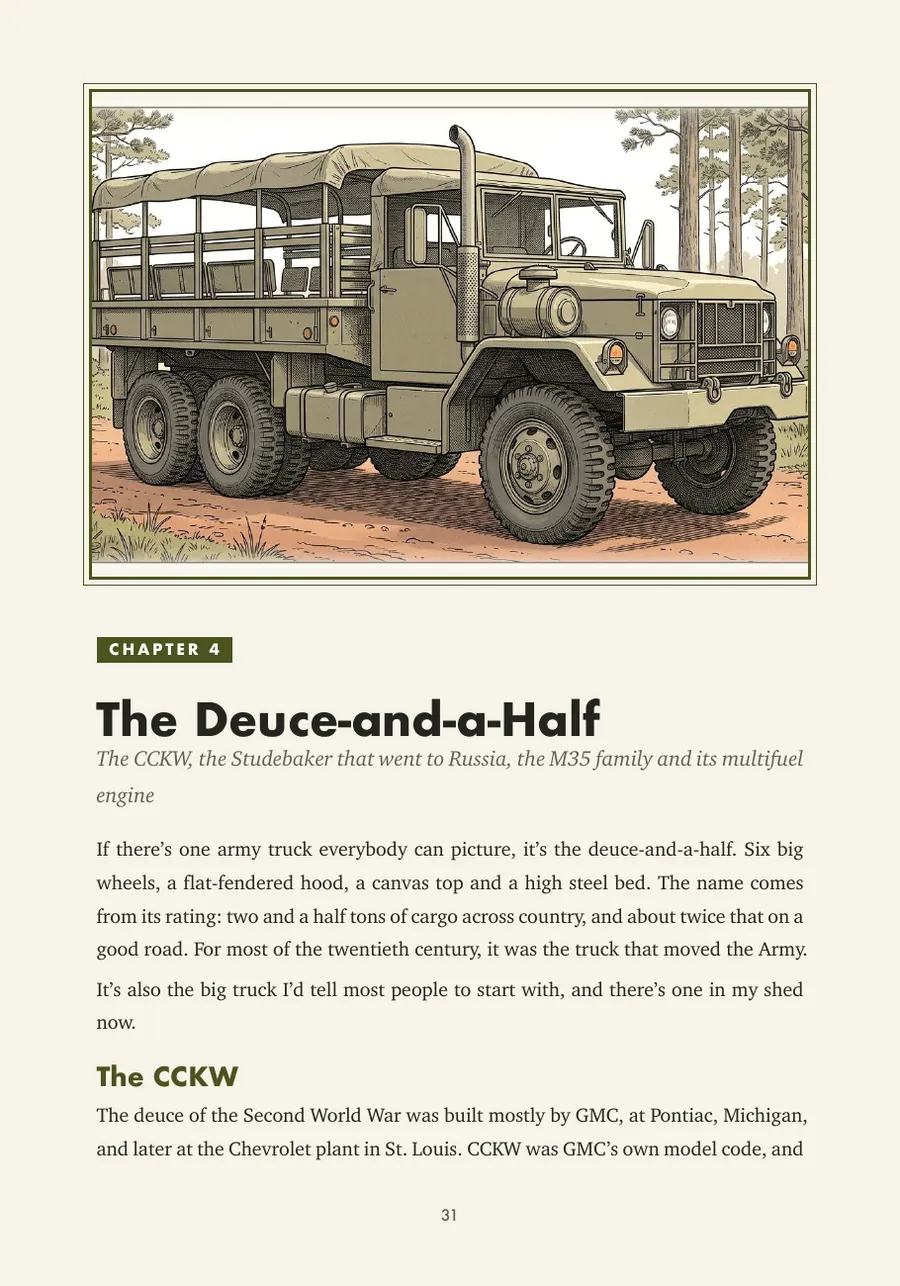
- The deuce-and-a-half. The CCKW, the Studebaker that went to Russia, the M35 family and the multifuel engine, drawn and explained.
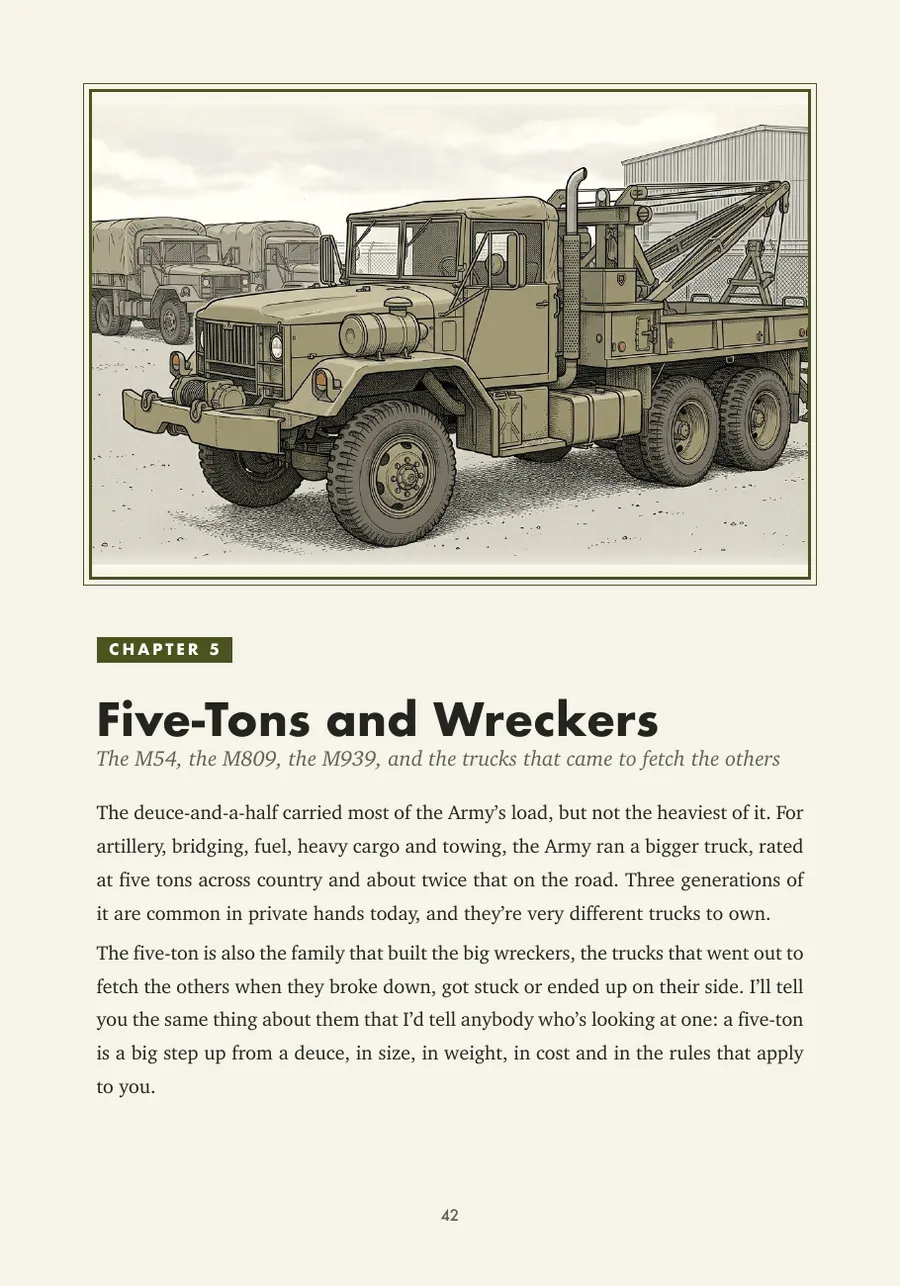
- Five-tons and wreckers. The M54, the M809, the M939 and the trucks sent to fetch the others home.
- The trailers that outlasted the trucks, which is not a joke, and the plates show why.
What's in the 127 pages
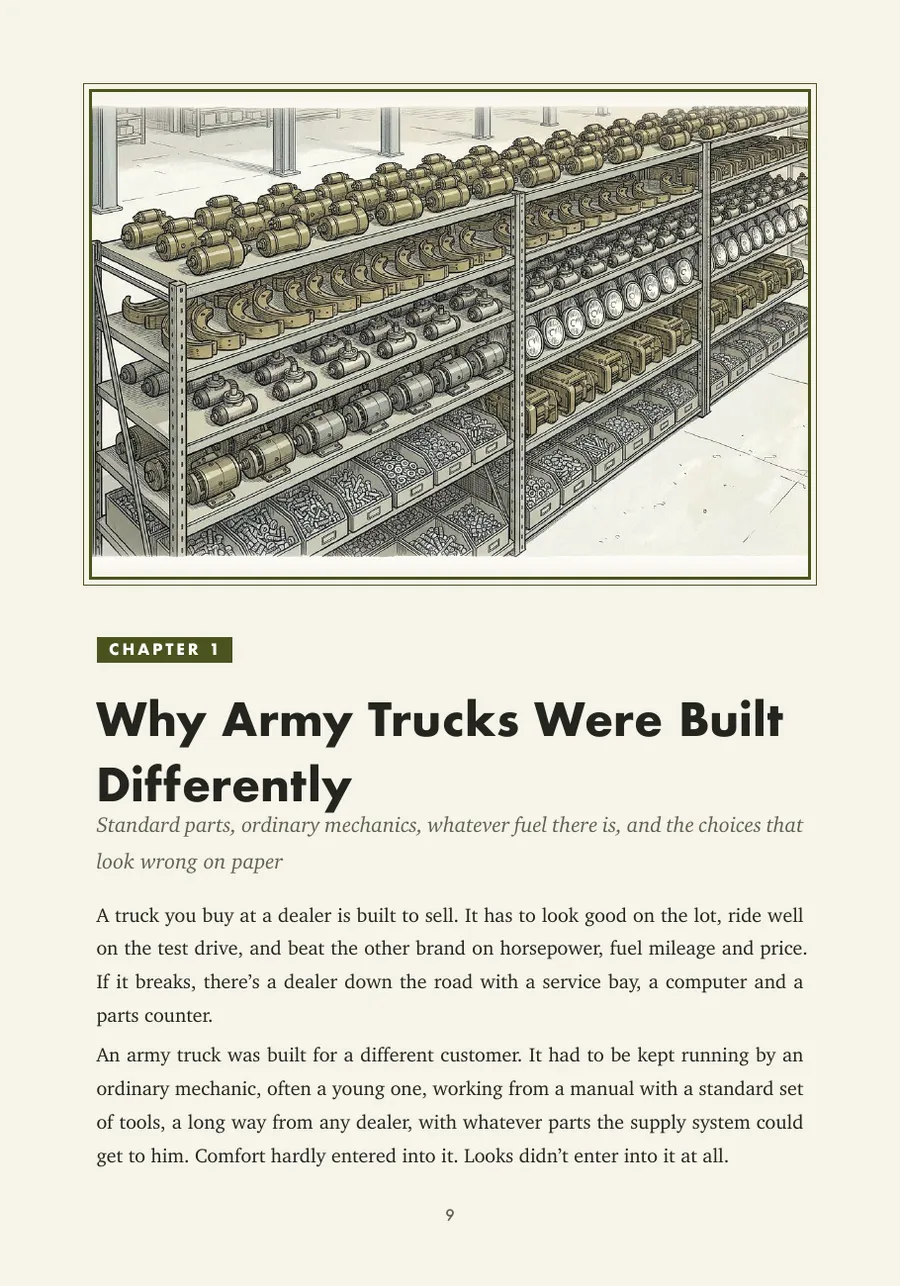
- Why army trucks were built differently: standard parts, repairs a man could make in a field, running on whatever fuel there was, 24 volts, and the "wrong" choices that bought decades.
- The 24-volt system made simple: two batteries, how to start one truck from another, fording, and what that extra switch on the dash actually does.
- Buying one, without the bad surprise: where they're sold, titles and license rules, value in rough tiers, the common troubles model by model, and a printable pre-purchase inspection.
- Keeping it running the depot way: reading a technical manual, the lubrication order, a service calendar, and a logbook that pays for itself.
- Driving one on today's roads: brakes, speed, visibility, fuel, parades, and the honest answer on what it's like to live with.
Four real pages
Army Trucks That Ran Forever
$29 · PDF · 127 pages · Instant PDF download
Everything in the book
- Introduction: The Truck That Was Still in Spec
- 1. Why Army Trucks Were Built Differently
- 2. The Jeeps
- 3. The M37 Three-Quarter-Ton
- 4. The Deuce-and-a-Half
- 5. Five-Tons and Wreckers
- 6. Civilian Trucks in Uniform
- 7. The Trailers That Outlasted the Trucks
- 8. The 24-Volt System
- 9. Maintenance the Depot Way
- 10. Owning One Today
- Appendix A: Spec Tables
- Appendix B: Timeline
- Appendix C: Which Truck Suits You
- Appendix D: Checklists to Print (before you buy, before every drive, during and after, buying worksheet, service record, log)
- Appendix E: Words You'll Hear
- Appendix F: The Manuals
- Appendix G: Spotter's Guide
The details
- Format
- Illustrated PDF ebook, full color
- Length
- 127 pages, 18 chapters
- Page size
- 7 × 10 in – reads well on a tablet, computer or phone
- Printing
- Print any page for your own use. Checklists included.
- Copy protection
- None. Download it and keep it.
- Delivery
- Instant. Download straight after you pay.
Who it's for
- You like old trucks and want the mechanical story told properly
- You own a military vehicle, or you're a year away from buying one
- You want the plates: accurate profiles, cutaways and spec tables in one place
- You'd rather read about engineering than about battles
- You want combat history. There is none in here, on purpose
- You want to apply "army lessons" to a modern car. Different machines, different rules

I'm Odel Tidwell. Anniston, Alabama.
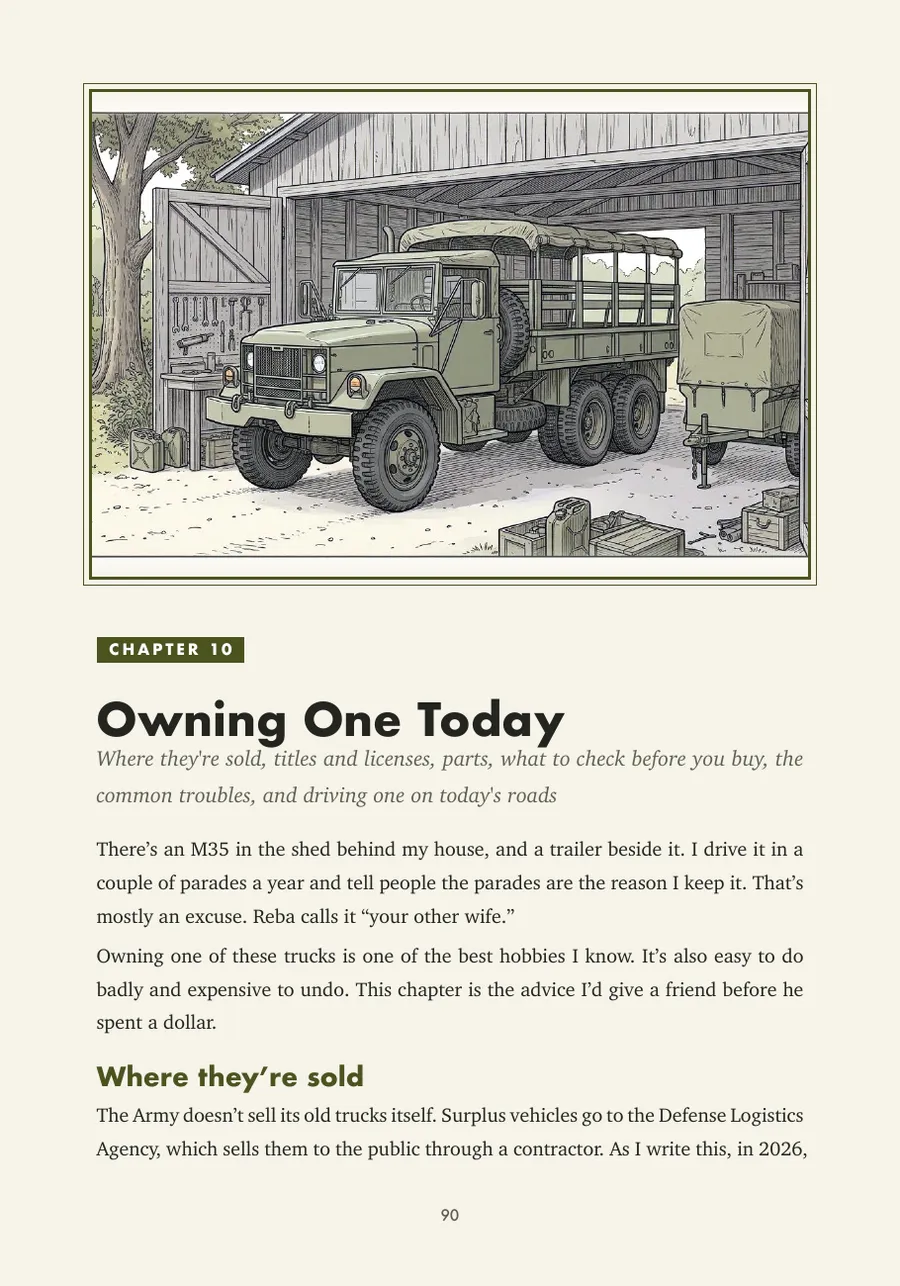
There's an M35 and a trailer in the shed behind my house. It goes to a couple of parades a year and I'll admit that's mostly an excuse to drive it. Reba calls it my other wife. I spent my working life taking machines apart and putting them back together, and this book is the part of that I think is worth passing on.
Go write it down.
Read it for 60 days. If it's not for you, I'll refund it.
Email support@oldhands.co within 60 days of buying and you get your money back in full. No questions, no forms, and you keep the file.
Questions
Is this a history book or a workshop manual?
Neither, exactly. It's an illustrated guide: what each truck is, why it was built that way, how the unusual systems work, and what ownership really involves.
Does it cover modern vehicles — Humvees and up?
It stops where these trucks stop. The CUCV and the M715 are in there as civilian trucks in uniform, and that's about as late as it goes.
I'll never own one. Is it still worth reading?
Most readers won't own one. The book was written so the plates and the engineering stand on their own.
How do I get it after I pay?
Checkout is handled by Whop, a payments company. The moment you pay, the PDF is in your Whop account to download, and the link is emailed to you as well. You can download it again any time.
Is this a printed book?
No. It's an ebook: a PDF you download straight after paying. You can print any page, or the whole thing, for your own use.
Will it open on my phone?
Yes. It's an ordinary PDF, so it opens on any phone, tablet or computer. A tablet or computer shows the pages best.
What if I don't like it?
Email support@oldhands.co within 60 days and you get a full refund. You don't need to give a reason.

$29, and the plates alone are worth it.
Spec tables, a timeline, a "which truck suits you" chart and a pre-drive checklist are all in the back.
- Instant PDF download
- 60-day money-back guarantee
- No copy protection – yours to keep
One-time payment. Sales tax or VAT is added at checkout where it applies.
It was built for the man who'd have to fix it. Go write it down.